Does Reconstituted Peptide Last as Long as the Sealed Vial? Myth vs. Fact
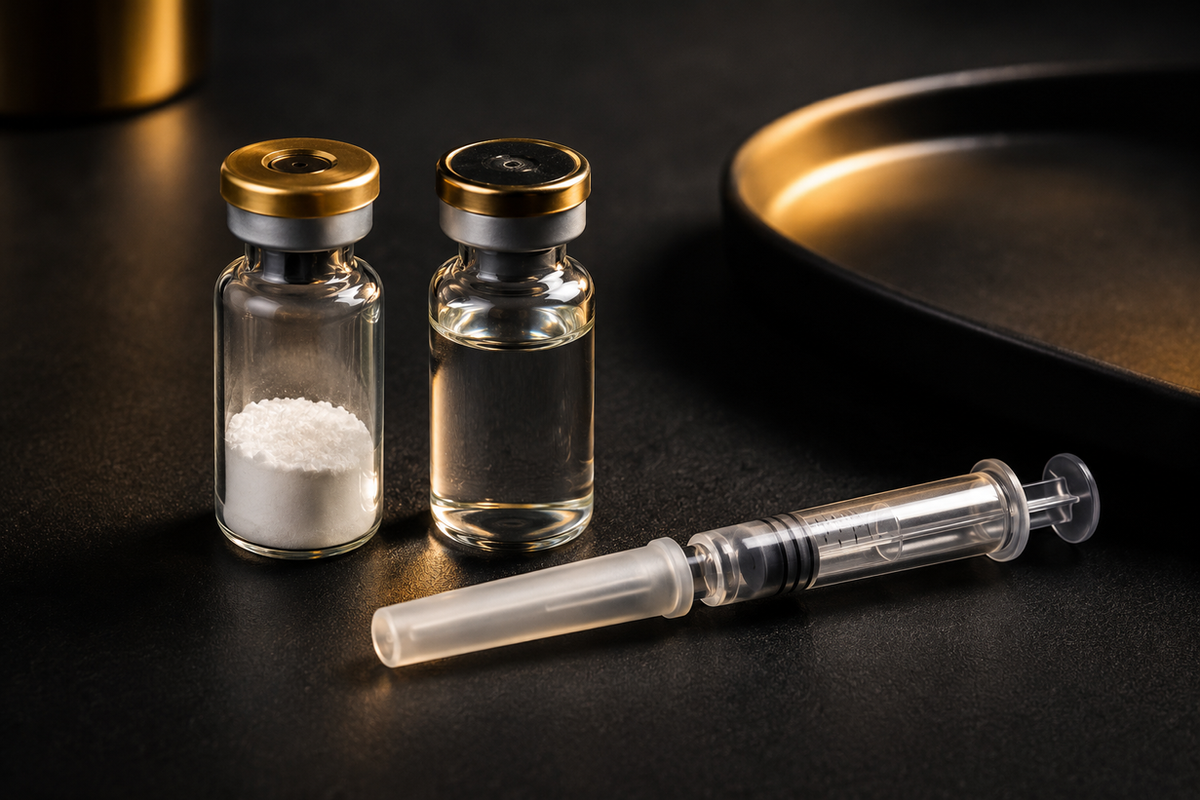
No — a reconstituted (mixed) peptide does not last as long as the sealed powder. The moment you add water, the degradation clock restarts: hydrolysis and related pathways reactivate, and potency can decline even while the liquid still looks perfectly clear. Stored refrigerated at 36–46°F, the commonly cited working window for a reconstituted vial is on the order of ~28 days (some sources say 4–6 weeks) — a fraction of the dry powder's shelf life. Keep it cold, keep it clean.
The myth
"Once it's mixed, it's fine for months — same as the powder in the freezer." Powder and solution are simply not the same stability problem.
The standard
Dry, lyophilized peptide is shelf-stable because there's no water to drive degradation. Add diluent and that protection is gone. After reconstitution, the guidance is to refrigerate at 36–46°F and use within a working window on the order of ~28 days — which lines up with the multi-use-vial contamination standard from USP <797> / CDC. Bacteriostatic water (with its 0.9% benzyl alcohol) buys more usable time than plain sterile water, because it inhibits microbial growth in a vial you'll access repeatedly.
The reality
Two clocks start ticking when you reconstitute: chemical (hydrolysis degrades the molecule) and microbial (each puncture is a contamination opportunity). Refrigeration slows both; bacteriostatic water helps on the microbial side. But "looks clear" is not "is potent" — a solution can lose activity invisibly. So treat mixed material as a short-shelf-life item: refrigerate it, wipe the stopper before each draw, minimize punctures, and don't expect powder-like longevity. And don't freeze the mixed vial — see the note below.
One caution: never freeze a reconstituted vial. Freeze–thaw cycling physically stresses the peptide and can reduce potency. Freeze the dry powder; refrigerate what's mixed. This is storage information for research supplies, not medical advice.
Get research-grade peptides and bacteriostatic water at Golden State Bio, and read why BAC water's 28-day rule is a safety standard, not an expiration.

Frequently Asked Questions
How long does a reconstituted peptide last in the fridge?
Refrigerated at 36–46°F, the commonly cited working window is on the order of ~28 days (some sources say 4–6 weeks). It's far shorter than the sealed dry powder, because adding water restarts the degradation clock.
Why does mixing shorten shelf life so much?
Peptide degradation pathways like hydrolysis need water. A dry powder has essentially none, so it's stable; a reconstituted solution reintroduces water and reactivates those pathways immediately — plus each puncture adds contamination risk.
Does bacteriostatic water make it last longer than sterile water?
It helps on the microbial side. Bacteriostatic water's 0.9% benzyl alcohol inhibits microbial growth, which supports a multi-use window; plain sterile water has no preservative. Neither stops the chemical (hydrolysis) clock.
Can I freeze a reconstituted vial to extend it?
No. Freeze–thaw cycling of a solution physically stresses the peptide and can reduce potency. Freeze dry powder for long-term storage; keep reconstituted vials refrigerated at 36–46°F.
Can a peptide lose potency even if it still looks clear?
Yes. Degradation can happen invisibly — a clear solution can still have lost activity. Appearance is a gross-defect check, not a potency test; lab testing (HPLC) is what actually confirms potency.
References
Peer-reviewed research and recognized standards that support the statements above. We cite primary sources so you can verify the science yourself. These references are provided for research context only and are not medical advice.
- Journal of Pharmaceutical Sciences. Effect of water on the chemical stability of amorphous pharmaceuticals: 2. Deamidation of peptides and proteins. J Pharm Sci. 2018;107(1):42–56. PMID 28923320 View source →
- U.S. Centers for Disease Control and Prevention. Questions about Multi-dose Vials (Injection Safety). CDC, Injection Safety — accessed 2026 View source →
- Journal of Pharmaceutical Sciences. Freezing-induced protein aggregation: characterization and mechanistic insights. J Pharm Sci. 2025. PMID 40021009 View source →

FOR LABORATORY AND RESEARCH USE ONLY. Golden State Bio supplies research-use-only chemicals for qualified researchers. Not for human or veterinary use; not evaluated by the FDA. Nothing here is medical advice.